Stocks vs. Bonds: Which Investment Is Right for You?
Stocks vs. Bonds
When it comes to investing, one of the most common questions beginners ask is:
“Should I invest in stocks or bonds?”
Both are cornerstones of a healthy investment portfolio, yet they behave very differently. Stocks promise higher returns but come with more risk. Bonds offer stability but tend to grow slower.
Choosing between the two — or understanding how to balance them — is one of the most important financial decisions you’ll ever make.
In this guide, we’ll explore stocks vs. bonds in depth: what they are, how they work, their pros and cons, and how to decide which investment fits your goals, risk tolerance, and time horizon.
How to Invest in the Stock Market for Beginners
1. Understanding the Basics: What Are Stocks and Bonds?
Before comparing, let’s start with what each investment really means.
a. What Are Stocks?
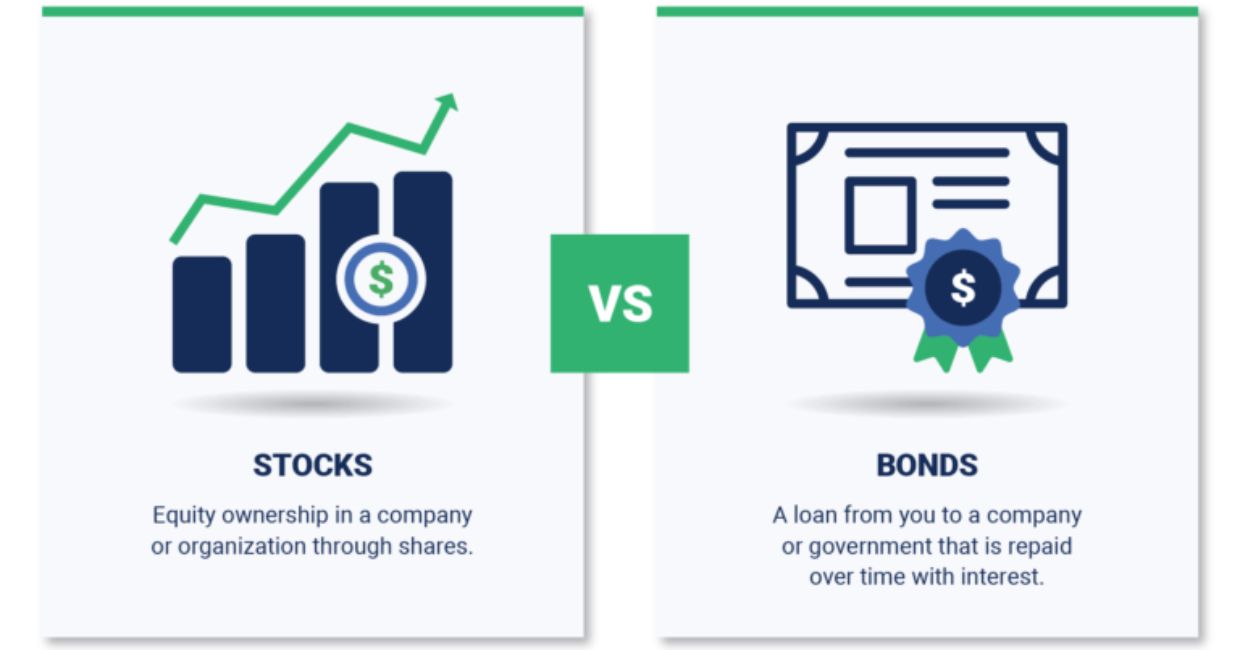
When you buy a stock, you’re purchasing ownership in a company. Each share represents a small piece of that business. If the company grows and becomes more profitable, the value of your shares typically increases.
You may also earn dividends — a portion of the company’s profits distributed to shareholders.
Stocks are traded on exchanges like the New York Stock Exchange (NYSE) or NASDAQ and are known for their potential to deliver high returns over the long term. However, they’re also volatile, meaning their prices can fluctuate daily.
In short:
Stocks = Ownership in a company with high return potential and higher risk.
b. What Are Bonds?
A bond is essentially a loan you give to a government or corporation. In return, they agree to pay you regular interest (called a coupon) and return the principal amount (your initial investment) at a fixed date in the future (the maturity date).
Bonds are typically more stable than stocks, which makes them attractive to conservative investors or those nearing retirement.
In short:
Bonds = A loan that pays fixed interest with lower risk and lower return.
2. The Key Difference Between Stocks and Bonds
The fundamental difference between stocks and bonds lies in ownership versus lending.
| Feature | Stocks | Bonds |
|---|---|---|
| Nature | Ownership in a company | Loan to a company or government |
| Returns | Dividends + price appreciation | Fixed interest income |
| Risk | Higher (market volatility) | Lower (depends on issuer) |
| Time Horizon | Long-term | Short- to medium-term |
| Liquidity | Highly liquid | Moderately liquid |
| Goal | Growth | Stability and income |
So, while stocks help your money grow faster, bonds help protect it when markets turn rough. Most successful investors use both — finding the right balance for their situation.
3. How Stocks Work: The Growth Engine of Your Portfolio
Stocks are the growth engine of most investment portfolios. When companies perform well, their stock prices increase, and shareholders benefit from both capital appreciation and dividends.
For example, if you had invested $1,000 in Apple in 2010, your investment would be worth over $20,000 by 2025 — thanks to massive growth and reinvested dividends.
How You Make Money with Stocks
- Capital Gains: The price of your stock rises, and you sell it for a profit.
- Dividends: Some companies share profits with investors regularly.
- Stock Splits and Buybacks: These corporate actions can increase shareholder value over time.
However, stock prices can also fall sharply due to poor earnings, market corrections, or economic downturns. That’s why stocks are ideal for investors with a long-term mindset — people who can handle short-term volatility for long-term growth.
4. How Bonds Work: The Stability Anchor of Your Portfolio
Bonds serve as the anchor that keeps your portfolio stable when stock markets fluctuate.
When you buy a bond, you’re essentially lending money to an entity (a company, city, or government) for a set period. In exchange, you receive regular interest payments — often semiannually — and your principal back when the bond matures.
Types of Bonds
- Government Bonds: Issued by federal governments (like U.S. Treasury Bonds). Considered very safe.
- Municipal Bonds: Issued by states or local governments. Often tax-free.
- Corporate Bonds: Issued by companies. Higher risk than government bonds but offer higher yields.
- High-Yield (Junk) Bonds: Issued by companies with lower credit ratings — riskier but pay more interest.
How You Make Money with Bonds
- Interest income: Regular fixed payments throughout the bond’s term.
- Capital gains: If you sell your bond for more than you paid.
Bonds are best for preserving capital and generating steady income, especially when stock markets are uncertain.
5. Risk vs. Reward: The Core Trade-Off
Every investment involves a trade-off between risk and reward.
Stocks: High Risk, High Reward
Stock prices can rise dramatically — but they can also fall just as fast. Economic recessions, poor management, or industry changes can wipe out stock values overnight.
However, historically, stocks have provided average annual returns of 7–10% after inflation over long periods.
Bonds: Low Risk, Low Reward
Bonds offer predictable returns and are less volatile. But their growth potential is limited — typically yielding 2–5% per year depending on interest rates and credit quality.
Example:
If you invest $10,000:
- In stocks, you might earn $70,000–$100,000 in 20 years.
- In bonds, you might earn $15,000–$25,000 in 20 years.
So, stocks grow wealth faster, while bonds preserve it.
6. How Economic Conditions Affect Stocks and Bonds
The performance of stocks and bonds often depends on broader economic trends.
a. When the Economy Is Growing
- Companies make more profits → Stock prices rise.
- Inflation and interest rates may rise → Bond prices fall.
So, stocks usually outperform bonds during economic booms.
b. When the Economy Is Slowing Down
- Companies struggle → Stock prices drop.
- Investors seek safety → Bond prices rise as demand increases.
That’s why bonds are often called a “safe haven” during recessions.
In short, the two tend to move in opposite directions, which is why a balanced portfolio of both offers stability.
7. Time Horizon: When You Need the Money Matters
Your investment timeline plays a major role in whether stocks or bonds are right for you.
If You Have a Long Time Horizon (10+ years):
You can handle stock market ups and downs because you have time to recover from downturns.
👉 Best choice: Stocks or stock-heavy portfolios.
If You Have a Short Time Horizon (1–5 years):
You’ll need your money soon, so minimizing risk is key.
👉 Best choice: Bonds or bond-heavy portfolios.
Example:
- A 25-year-old saving for retirement (age 65) can invest mostly in stocks (about 80–90%).
- A 60-year-old nearing retirement might shift toward bonds (60–70%) for stability.
8. Diversification: Why You Shouldn’t Choose Only One
The truth is — you don’t have to choose just one.
In fact, the smartest investors use both stocks and bonds to create a diversified portfolio.
Diversification spreads your risk across different assets. When stocks fall, bonds often rise — and vice versa. This balance helps smooth out returns over time.
Example Portfolio Mixes
| Investor Type | Stocks | Bonds | Risk Level |
|---|---|---|---|
| Aggressive | 90% | 10% | High |
| Moderate | 60% | 40% | Medium |
| Conservative | 40% | 60% | Low |
As you get older or closer to your financial goals, you can rebalance your portfolio — shifting gradually from stocks to bonds.
9. Pros and Cons of Stocks
Pros
✅ High long-term growth potential
✅ Dividends can provide passive income
✅ Easy to buy and sell (high liquidity)
✅ Beat inflation over time
Cons
❌ High volatility (values fluctuate daily)
❌ No guaranteed returns
❌ Emotional investing can lead to losses
❌ Can lose money if you sell during downturns
10. Pros and Cons of Bonds
Pros
✅ Stable, predictable income
✅ Safer than stocks
✅ Protects capital in market downturns
✅ Good diversification tool
Cons
❌ Lower returns
❌ Can lose value if interest rates rise
❌ Inflation can erode real returns
❌ Some corporate bonds carry credit risk
11. The Role of Age and Risk Tolerance
Your age and risk tolerance play major roles in deciding your mix of stocks and bonds.
A common rule of thumb is:
Subtract your age from 100 (or 110) — that number is the percentage of your portfolio to keep in stocks.
For example:
- If you’re 30 → 80% stocks, 20% bonds
- If you’re 60 → 50% stocks, 50% bonds
This ensures your portfolio becomes more conservative as you approach retirement.
12. Inflation: The Silent Wealth Killer
Inflation slowly reduces your purchasing power.
While bonds provide stability, they often can’t keep up with inflation. If inflation is 4% and your bond yields 3%, you’re effectively losing 1% each year in real terms.
Stocks, on the other hand, tend to outpace inflation over time, since companies can raise prices and increase profits.
This is why younger investors usually benefit more from stock-heavy portfolios.
13. Tax Implications
Stocks
- Dividends may be taxed as income or at a lower capital gains rate.
- Capital gains tax applies when you sell for a profit.
- Holding for over a year qualifies for long-term capital gains, which are taxed less.
Bonds
- Interest income is typically taxed as ordinary income.
- Some government or municipal bonds offer tax-free interest.
If you invest through retirement accounts (like a 401(k) or IRA), your returns grow tax-deferred or even tax-free.
14. Real-World Example: How Stocks and Bonds Work Together
Let’s look at two investors:
Investor A – All Stocks
Invests $10,000 in stocks and earns an average of 8% per year. After 20 years:
→ Portfolio grows to $46,610
But experiences big ups and downs along the way.
Investor B – 60% Stocks, 40% Bonds
Earns a blended return of about 6% per year. After 20 years:
→ Portfolio grows to $32,071
But with fewer losses during market crashes.
This shows that diversification might reduce your top-end returns but greatly increases consistency and peace of mind.
15. When to Choose Stocks
Choose stocks if:
- You’re investing for the long term (10+ years).
- You can handle volatility.
- You want to grow wealth aggressively.
- You’re okay with taking risks for higher rewards.
Perfect for:
- Young professionals
- Long-term retirement planners
- Those with strong risk tolerance
16. When to Choose Bonds
Choose bonds if:
- You need steady income.
- You’re close to retirement.
- You want to preserve capital and minimize losses.
- You’re conservative or risk-averse.
Perfect for:
- Retirees
- People saving for short-term goals
- Investors seeking balance and stability
17. How to Invest in Stocks and Bonds
You can invest in both easily using:
- Brokerage accounts: Fidelity, Vanguard, Charles Schwab, etc.
- Robo-advisors: Betterment, Wealthfront, or SoFi Invest.
- ETFs or mutual funds: For instant diversification.
- Retirement accounts: 401(k), IRA, or Roth IRA.
Start small, automate contributions, and reinvest your returns to build wealth steadily.
18. How to Find Your Ideal Mix
There’s no one-size-fits-all approach — your ideal mix depends on your:
- Age
- Income
- Goals
- Risk tolerance
- Time horizon
If you’re unsure, consider starting with a balanced 60/40 portfolio (60% stocks, 40% bonds) and adjust over time as your needs evolve.
19. Rebalancing: Keeping Your Portfolio on Track
Over time, your investments will grow at different rates. If stocks perform well, they might make up more of your portfolio than intended.
That’s why it’s important to rebalance annually — selling a little of what’s gained too much and buying what’s lagging — to restore your desired stock/bond ratio.
This keeps your portfolio aligned with your goals and risk level.
20. Final Thoughts: Finding the Right Balance
When it comes to stocks vs. bonds, there’s no universal answer.
- Stocks are the engine of growth.
- Bonds are the seatbelt of safety.
The right choice depends on who you are as an investor — your goals, age, and comfort with risk.
If you want long-term growth and can handle market swings, stocks should dominate your portfolio.
If you value stability and predictable income, bonds should take the lead.
But the smartest strategy? Combine both.
A well-balanced mix of stocks and bonds gives you the growth you want and the protection you need.
Conclusion
Building wealth is about balance and discipline, not just picking one investment over another.
Stocks and bonds each have unique strengths — and when used together, they form the foundation of a strong, diversified portfolio.
Whether you’re 25 and just starting out, or 60 and planning for retirement, understanding how stocks and bonds work will empower you to make smarter financial decisions and achieve long-term success.
Your investment journey doesn’t start with choosing between stocks or bonds — it starts with understanding how both can work for you.